I designed and deployed a state-of-the-art AI chat and voice receptionist for FamilyHealth Clinic that delivers low-latency, human-like conversations while handling appointment scheduling, FAQs, and operational workflows in real time.
The Problem
Dental and medical clinics face constant front-desk overload. Staff must manage high call volumes, complex appointment scheduling, and repetitive FAQs while providing a high level of patient care.
Generic chatbots and traditional IVR systems fail because they:
- Feel robotic, rigid, and frustrating to use
- Lack real-time access to operational data like calendars
- Struggle with multi-turn memory and complex intent
- Miss critical calls outside of business hours
The challenge: build a voice-first AI receptionist that feels natural, responds instantly, remembers context, and books real appointments — without introducing operational risk.
The Solution
FamilyHealth Voice AI is a real-time conversational receptionist powered by a directed orchestration graph and low-latency LLM inference.
Unlike static voice bots, this system performs structured reasoning across multiple services while maintaining conversational fluidity under one second response times. The system combines precise intent classification with RAG-based knowledge retrieval and live calendar integration.
System Architecture
The system utilizes a DAG-based (Directed Acyclic Graph) architecture to ensure deterministic routing and predictable state transitions:
- Entry: Voice calls (Vapi) or web chat messages enter a LangGraph DAG
- Classification: Intent is analyzed using Groq (Llama-3.1-8B)
- Parallel Processing: Pinecone RAG results are pre-fetched while routing occurs
- Deterministic Routing: Flow is directed to specialized nodes (FAQ, Booking, etc.)
- Logic Flow: Booking flow interacts with Google Calendar API for live availability
- Reasoning: Primary conversational logic handled by Groq GPT-OSS-20B
- Persistence: Conversation state is maintained via a SQLite checkpointer or Redis
- Streaming: Responses are streamed via SSE for minimal perceived latency
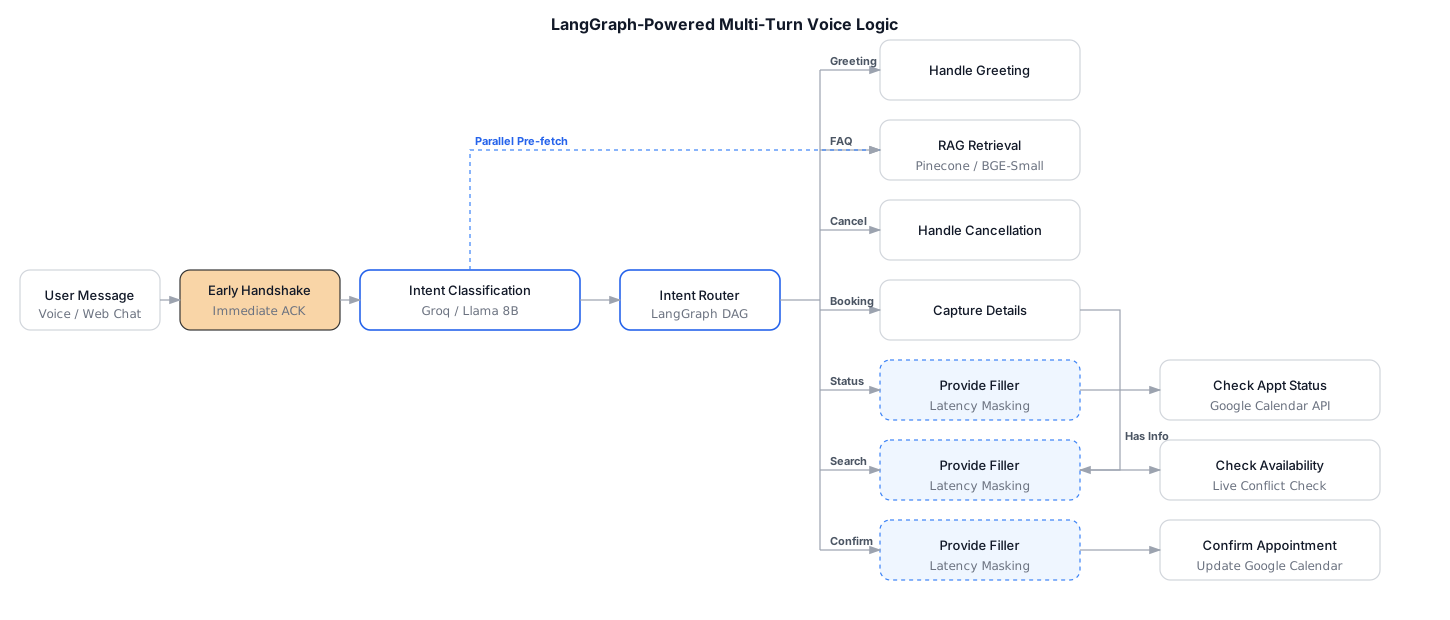
This design ensures deterministic routing, parallel task execution, and predictable state transitions.
Key Engineering Decisions
Orchestration: LangChain LangGraph
Chosen for graph-based state control rather than linear chains. This prevents memory resets and allows branching logic for booking, FAQs, and cancellations without conversational drift.
Ultra-Low Latency Inference: Groq
Groq’s LPU stack enables sub-second responses, critical for voice systems where silence degrades user trust. Intent classification and reasoning are separated across models to balance speed and depth.
RAG Infrastructure: local BGE-Small & Pinecone
Used for real-time retrieval of clinic procedures, pricing, and operational FAQs. I chose a local BGE-Small embedding model to ensure data privacy and zero-latency embedding API calls. Parallel async pre-fetching reduces perceived latency by 30–40%.
Scheduling Integration: Google Calendar API
Direct API integration enables live availability checks and conflict prevention, transforming the assistant from an informational bot into a functional operational system.
Latency Masking Strategy
Voice systems cannot tolerate silence. To ensure continuity, I implemented:
- Async RAG pre-fetch during initial intent classification
- Streaming responses via Server-Sent Events (SSE)
- Status signals and filler acknowledgments during heavy API call execution
Multi-Channel Delivery: Voice & Web
The system is designed for high-stakes interactions across two distinct layers, ensuring consistent intelligence regardless of the medium.
Native Voice (Vapi Integration)
The backend is a Custom LLM Provider for Vapi, implementing the protocol via SSE. It maps call IDs to LangGraph threads to maintain persistent state and conversational memory throughout the call.
Visual Web Chat
The companion web interface built in Typescript provides real-time streaming with status indicators for RAG and Calendar lookups. Each session maintains thread persistence, allowing users to switch between voice and text without losing context.
Core Capabilities
- Natural conversational voice flow with barge-in support
- Multi-turn memory with persistent conversational state
- RAG-powered FAQ handling for procedures and clinic data
- Real-time appointment booking and cancellation via Google Calendar
- Multi-channel delivery (Synchronous Voice + Asynchronous Web Chat)
- Automated SMS notifications and confirmations via Twilio
Outcome & Impact
- Delivered a fully operational AI receptionist that operates autonomously via Voice and Web Chat 24/7
- Significantly reduced front-desk workload by handling routine FAQs and scheduling
- Maintained sub-second conversational responsiveness across diverse intents
- Built a modular architecture adaptable for various service offices and practices
This project demonstrates applied AI engineering beyond experimentation — with real deployment constraints in mind.
Live Demo
▶ Try the system live on Hugging Face
An interactive demo running in a production-style environment.
Skills Demonstrated
- Voice AI System Design & Deployment
- Graph-Based Orchestration (LangGraph)
- RAG for Real-Time Knowledge Recall
- Low-Latency LLM Inference Optimization (Groq)
- Parallel Async Processing (Pre-fetching)
- API Integration (Google Calendar, Twilio)
- Advanced State Management & Memory
Planned Improvements
- Advanced analytics dashboard for call performance and booking success
- Multi-location and role-based escalation paths
- Structured evaluation benchmarks for latency and intent accuracy
Why This Project Matters
Voice interfaces demand more than accurate responses — they require timing, reliability, and operational integration. This system shows how Voice AI can move beyond scripted interactions to become a functional part of real-world service infrastructure.