I designed and deployed a production-ready voice AI assistant that enables natural, real-time conversations by orchestrating speech detection, transcription, reasoning, and speech synthesis in a single low-latency pipeline.
The Problem
Most voice assistants fail in real-world usage due to latency, poor speech detection, robotic audio output, or high operational costs. Systems often record silence, misinterpret background noise, or generate responses that sound unnatural when spoken aloud.
For conversational AI to feel usable, it must:
- Detect when a user is actually speaking
- Respond quickly enough to feel interactive
- Produce audio that sounds natural, not synthetic
- Maintain conversational context across turns
The challenge: build a voice-first AI system that feels responsive, human, and production-ready — not experimental.
The Solution
This project is a multimodal AI voice assistant that combines real-time speech detection, transcription, LLM reasoning, and high-quality text-to-speech into a single cohesive system.
The assistant listens intelligently, reasons accurately, and responds with natural-sounding speech — while minimizing unnecessary API calls and latency.
System Architecture
The system is designed as a low-latency, modular pipeline:
- Client-side Voice Activity Detection (VAD) analyzes audio energy in real time
- Only validated speech is sent for transcription
- Whisper (via Groq) converts speech to text
- LLaMA 3 (70B) generates a contextual response
- Output text is cleaned and optimized for speech
- A TTS router selects the best available voice provider
- Audio is streamed back to the user
- Session-based memory maintains conversational context
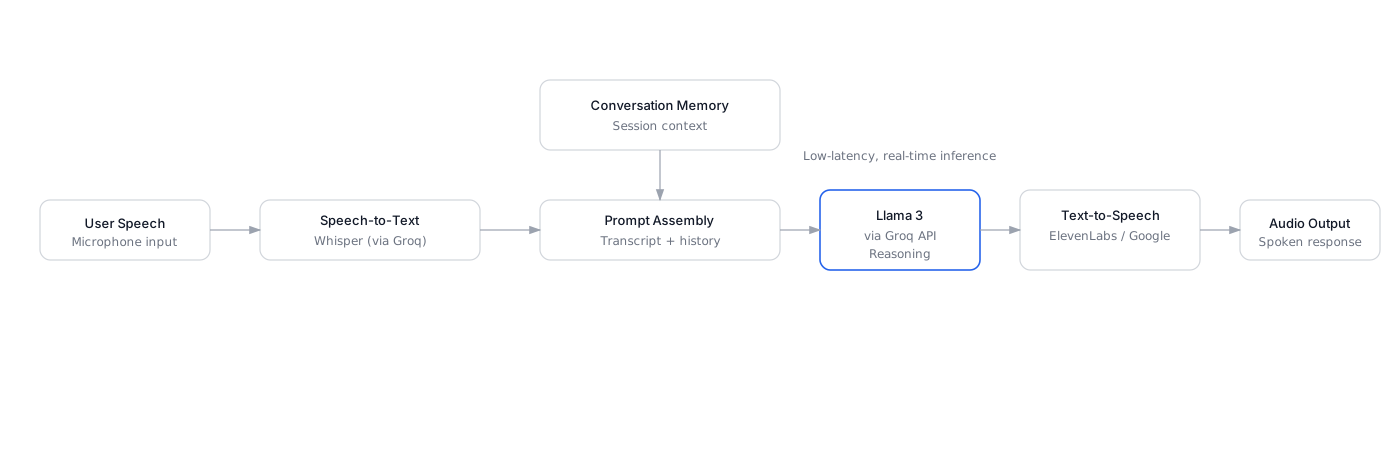
This architecture ensures both responsiveness and cost efficiency.
Key Engineering Decisions
Client-Side Voice Activity Detection (VAD)
Rather than relying on server-side filtering, the system performs RMS-based speech detection on the client. This prevents silent or noisy audio from being sent to the backend, reducing costs and improving responsiveness across all languages.
Ultra-Fast Inference with Groq
Both Whisper (STT) and LLaMA 3 (LLM) are served via Groq to minimize end-to-end latency, enabling near real-time conversational flow.
Multi-Provider TTS Architecture
The system supports multiple TTS providers with automatic routing:
- ElevenLabs for premium, human-like voices
- Google Cloud TTS as a reliable low-cost fallback
This design avoids single-provider lock-in and improves system resilience.
Session-Based Memory Management
Each user session maintains its own conversational state, enabling coherent multi-turn conversations while remaining Docker-compatible and safe for concurrent users.
Core Capabilities
- Real-time voice interaction with intelligent speech detection
- Multilingual speech-to-text and text-to-speech support
- Natural-sounding audio output with multiple voice profiles
- Persistent conversational memory across turns
- Cost-optimized audio processing pipeline
- Fully containerized deployment for cloud or local environments
Production-Grade Implementation
- Backend: Flask-based orchestration layer
- STT: Groq-hosted Whisper Large v3
- LLM: LLaMA 3 (70B) via Groq
- TTS: ElevenLabs + Google Cloud Text-to-Speech
- Frontend: Lightweight web UI with client-side audio processing
- Deployment: Docker & Docker Compose
The system was engineered with stability, latency, and extensibility in mind.
Performance Characteristics
- Speech-to-Text: ~300 milliseconds
- LLM Reasoning: ~500 milliseconds
- Text-to-Speech: ~400 milliseconds (ElevenLabs)
- End-to-End Interaction: ~1.2 seconds per conversational turn
These timings enable smooth, natural-feeling dialogue.
Outcome & Impact
- Built a fully integrated multimodal AI assistant from microphone input to spoken response
- Reduced unnecessary API usage through intelligent audio preprocessing
- Demonstrated production-level handling of latency, cost, and user experience
This project showcases applied AI engineering beyond text — integrating audio, language, and system design.
Live Demo
▶ Try the AI Voice Assistant live on Hugging Face
Interact with the system in real time and experience the full voice pipeline in action.
Skills Demonstrated
- Multimodal AI System Design
- Speech-to-Text & Text-to-Speech Pipelines
- Low-Latency LLM Orchestration
- Client-Side Signal Processing
- Dockerized AI Deployment
- Conversational UX Engineering
Planned Improvements
- Streaming partial responses for faster perceived latency
- Advanced turn-taking and interruption handling
- User authentication and voice personalization
- Expanded multilingual optimization
Why This Project Matters
Voice interfaces succeed or fail on responsiveness and conversational flow. This project focuses on reducing latency and preserving context so interactions feel natural rather than fragmented or delayed.
Want such a system custom built for your business?
I specialize in designing and deploying production-grade AI agents that solve real operational challenges. Let's discuss how we can automate your high-stakes workflows.
Contact Me